With the current IPO market somewhat uncertain as a
result of Brexit, investor confidence in companies looking to list on
the London Stock Exchange is difficult to gauge. Despite the total
number of listings being approximately 50% down on this time last year,
the environment within which the successful floats have occurred is
important to note. Whilst high profile floats such as Misys have hit
turbulent headwinds and been forced to shelve their IPO plans in recent
times, others have flourished in demanding circumstances. Hollywood
Bowl Group, the operator of bowling centres, completed their IPO with a
market capitalisation of £240m; Autins Group, the insulation company,
floated on AIM raising £26m; and Luceco plc, the British electronics
company, listed at a market capitalisation of £209m earlier this
month.
London’s Q4 IPO landscape continues to look resilient
with three noteworthy floats: ConvaTec Group Plc, the medical products
company achieved the largest float of the year with a market cap of
£4.39bn; FreeAgent Holdings plc, provider of cloud based SaaS accounting
software solutions for small UK businesses raised £10.7m with a market
cap of £34.1m; and Filta Group, the kitchen specialist raised £6.2m on
AIM with a market cap of £22.4m. GoCompare.com,
the price comparison website also intends to float on the LSE for around
£400m following its successful demerger from Esure. In fact,
over 27 companies, including TimeOut and Hotel Chocolat, had floated on
AIM by H1 2016 for a combined value of $1.2bn – a 72% increase on the
same half the previous year. Moreover, the average market cap of AIM
companies has been growing steadily and is now at an all-time high of
£83.0m in 2016. These trends empirically validate the position that,
whilst Brexit may have temporarily affected IPO confidence, there is
still a healthy appetite for companies going public on the London
markets at a realistic price.
This notion of market resilience
is endorsed by the head of Ernst and Young’s IPO leader for UK and
Ireland, Scott McCubbin, who predicted earlier this month that there
will be a resurgence in UK IPOs in 2017 as companies and investors
acclimatise to post-Brexit market conditions.
With interest
rates remaining in the doldrums, Abchurch believes that the London Stock
Exchange will remain a highly competitive exchange for future IPOs in
the final quarter of 2016 and looks forward to more IPO activity in
2017.
Showing posts with label financial PR. Show all posts
Thursday, 8 December 2016
Friday, 30 October 2015
Weekly Wrap Up: TalkTalk couldn’t walk the walk
“We're currently making security enhancements to our website, which should be back online soon.”
This is the message that you are greeted with on the website for one of the world’s biggest telecoms group, TalkTalk PLC. On Thursday 21 October the news broke that police had commenced a criminal investigation into the cyber-attack on TalkTalk, leaving 4.2million customers’ details including contact numbers and payment information exposed. However, the Company managed to disclose the news 24 hours after they had been made aware. The share price subsequently nosedived 10 per cent as further revelations were disclosed with regards to exactly what and who had been effected and statements from CEO Dido Harding claiming ”stolen customer data may not have been securely encrypted” did little to keep their head above water.
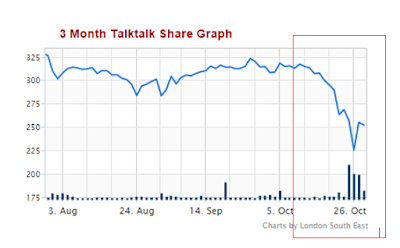
Would the graph look so similar if the company had developed a better, more stringent crisis communications strategy? Looking at Fig.1 the share price dipped during August. This depicts one of the two previous data breaches that the Company suffered and had this not been dismissed as a ‘blip’ then potentially the topography of this share graph would tell a different story.
Crisis communications, if not a desired consideration, should be ready and waiting in reserve to protect your company from any future bad news or operating faults, that you can respond in the most efficient, transparent and effective way to uphold your reputation as well as the safety of your customers and shareholders. Information security consultant Paul Moore rightly so states that ‘more worrying than the breach itself, had been TalkTalk's response to it’. There is a key to addressing the many communications issues related to crisis and disaster, of which TalkTalk have not handled correctly:
1. Anticipation of crisis:
Problem: TalkTalk had previously become exposed to data hacking and therefore should have placed measures to not only protect networks but individual data
It is not a matter of if it is a matter of when, cyber security especially is a must for companies storing the details of consumers, preparation is key.
2. Assessing the risks:
Problem: TalkTalk claim that they are unsure as to whether the data of customers bank details were encrypted, as confirmed by the broadband provider
With the level of technology available a company must have access to analogous detail, this is a good message to send to your shareholders if not your customers.
3. Communication and notification:
Problem: The lag time in notification from security breach to announcing this to their customers. People were left puzzled as to why the website was ‘closed for maintenance’ on Wednesday morning.
How will your news be shared with investors and/or the public, the quicker and more direct the better. Trust is based on communication and evidently leaving your investors and customers in the dark can break that trust.
4. Evaluation and analysis:
Problem: TalkTalk failed to learn from previous crisis: fail to plan - plan to fail
After the smoke clears revise the reaction and handling to secure your anticipation methods, think of the crisis as a vaccination, you come out stronger.
Hindsight is a beautiful thing however in the business world companies like TalkTalk cannot afford to simply tape up holes in the structure of their strategy of crises management.
Specifically cyber intelligence is advancing faster than some companies can develop their defenses, both systematically and managerially there is a drive to evolve rapidly to build resistance for the future and crisis. If a company can develop and format a clear and concise crisis management scheme then it should in theory be ahead of the game and ‘hacking’ can return to Horse and Hound.

This week, Abchaps hosted a market lunch, where respective opportunities in the M&A and IPO markets, as well as issues surrounding diversity in the City, were discussed. Our CEO Julian Bosdet also attended a dinner hosted by Nabarro to discuss the development of AIM.
KPMG has appointed Catherine Grum as its Head of Family Office. She joins from Salamanca Group where she was Managing Director and Head of the Private Office. Daniel Williams has been appointed global head of internal audit at the IG Group, having previously been head of internal audit for Europe, the Middle East and Africa at BGC Partners. Finally, Macquarie Investment Management appointed Gillian Evans as head of UK institutional distribution. She joins after 10 years at Goldman Sachs.
“Blip” - an unexpected, minor, and typically temporary deviation from a general trend.
Fed up with Halloween already? On Saturday, Regent Street’s sweep from Piccadilly Circus to Oxford will be filled with bumper to bumper cars as the UK’s largest free-entry motoring show rolls into town. Containing vehicles of all ages and abilities, from veteran cars straight out of period dramas to racing and eco automobiles, this year’s showstopper will include Aston Martin’s bespoke DB10, created especially for the new Bond film ‘Spectre’, of which only 10 were made for filming, out of which only 3 survived.
If you happen to be a car fanatic, the following day (Sunday 1 November).some of the classic cars involved will assemble again, early in the morning in Hyde Park, before setting off to Brighton for the London to Brighton Veteran Car Run. This annual event began in 1896 when the law requiring motorists to have a man bearing a red flag preceding their cars was abolished. Car owners celebrated by destroying their flags and setting off for Brighton in the 'Emancipation Run'. The first organised run took place in 1993 and today the event attracts owners of veteran cars built pre-1905 from all over the world.
Christmas really is approaching as the Oxford Street Christmas lights are switched on this Sunday. The Oxford Street Christmas lights will see 1778 snowball-like decorations (and their 750,000 LED lightbulbs) lit up once again for what is the fifty-sixth year the road has been decorated for the festive period. In a subtle upgrade from last year's display, 445 new golden baubles will twinkle among the existing silver lights. Kylie Minogue will do the honours, and a stage outside the Pandora Marble Arch store will host live musical performances and celebrity presenters from 5.30pm including Foxes, Fleur East, Gabrielle Alipin, ‘X-Factor’ winner Ben Haenow and performers from ‘Matilda the Musical’.
Follow us on Twitter @AbchurchComms

This is the message that you are greeted with on the website for one of the world’s biggest telecoms group, TalkTalk PLC. On Thursday 21 October the news broke that police had commenced a criminal investigation into the cyber-attack on TalkTalk, leaving 4.2million customers’ details including contact numbers and payment information exposed. However, the Company managed to disclose the news 24 hours after they had been made aware. The share price subsequently nosedived 10 per cent as further revelations were disclosed with regards to exactly what and who had been effected and statements from CEO Dido Harding claiming ”stolen customer data may not have been securely encrypted” did little to keep their head above water.
Would the graph look so similar if the company had developed a better, more stringent crisis communications strategy? Looking at Fig.1 the share price dipped during August. This depicts one of the two previous data breaches that the Company suffered and had this not been dismissed as a ‘blip’ then potentially the topography of this share graph would tell a different story.
Crisis communications, if not a desired consideration, should be ready and waiting in reserve to protect your company from any future bad news or operating faults, that you can respond in the most efficient, transparent and effective way to uphold your reputation as well as the safety of your customers and shareholders. Information security consultant Paul Moore rightly so states that ‘more worrying than the breach itself, had been TalkTalk's response to it’. There is a key to addressing the many communications issues related to crisis and disaster, of which TalkTalk have not handled correctly:
1. Anticipation of crisis:
Problem: TalkTalk had previously become exposed to data hacking and therefore should have placed measures to not only protect networks but individual data
It is not a matter of if it is a matter of when, cyber security especially is a must for companies storing the details of consumers, preparation is key.
2. Assessing the risks:
Problem: TalkTalk claim that they are unsure as to whether the data of customers bank details were encrypted, as confirmed by the broadband provider
With the level of technology available a company must have access to analogous detail, this is a good message to send to your shareholders if not your customers.
3. Communication and notification:
Problem: The lag time in notification from security breach to announcing this to their customers. People were left puzzled as to why the website was ‘closed for maintenance’ on Wednesday morning.
How will your news be shared with investors and/or the public, the quicker and more direct the better. Trust is based on communication and evidently leaving your investors and customers in the dark can break that trust.
4. Evaluation and analysis:
Problem: TalkTalk failed to learn from previous crisis: fail to plan - plan to fail
After the smoke clears revise the reaction and handling to secure your anticipation methods, think of the crisis as a vaccination, you come out stronger.
Hindsight is a beautiful thing however in the business world companies like TalkTalk cannot afford to simply tape up holes in the structure of their strategy of crises management.
Specifically cyber intelligence is advancing faster than some companies can develop their defenses, both systematically and managerially there is a drive to evolve rapidly to build resistance for the future and crisis. If a company can develop and format a clear and concise crisis management scheme then it should in theory be ahead of the game and ‘hacking’ can return to Horse and Hound.

This week, Abchaps hosted a market lunch, where respective opportunities in the M&A and IPO markets, as well as issues surrounding diversity in the City, were discussed. Our CEO Julian Bosdet also attended a dinner hosted by Nabarro to discuss the development of AIM.
KPMG has appointed Catherine Grum as its Head of Family Office. She joins from Salamanca Group where she was Managing Director and Head of the Private Office. Daniel Williams has been appointed global head of internal audit at the IG Group, having previously been head of internal audit for Europe, the Middle East and Africa at BGC Partners. Finally, Macquarie Investment Management appointed Gillian Evans as head of UK institutional distribution. She joins after 10 years at Goldman Sachs.
“Blip” - an unexpected, minor, and typically temporary deviation from a general trend.
Fed up with Halloween already? On Saturday, Regent Street’s sweep from Piccadilly Circus to Oxford will be filled with bumper to bumper cars as the UK’s largest free-entry motoring show rolls into town. Containing vehicles of all ages and abilities, from veteran cars straight out of period dramas to racing and eco automobiles, this year’s showstopper will include Aston Martin’s bespoke DB10, created especially for the new Bond film ‘Spectre’, of which only 10 were made for filming, out of which only 3 survived.
If you happen to be a car fanatic, the following day (Sunday 1 November).some of the classic cars involved will assemble again, early in the morning in Hyde Park, before setting off to Brighton for the London to Brighton Veteran Car Run. This annual event began in 1896 when the law requiring motorists to have a man bearing a red flag preceding their cars was abolished. Car owners celebrated by destroying their flags and setting off for Brighton in the 'Emancipation Run'. The first organised run took place in 1993 and today the event attracts owners of veteran cars built pre-1905 from all over the world.
Christmas really is approaching as the Oxford Street Christmas lights are switched on this Sunday. The Oxford Street Christmas lights will see 1778 snowball-like decorations (and their 750,000 LED lightbulbs) lit up once again for what is the fifty-sixth year the road has been decorated for the festive period. In a subtle upgrade from last year's display, 445 new golden baubles will twinkle among the existing silver lights. Kylie Minogue will do the honours, and a stage outside the Pandora Marble Arch store will host live musical performances and celebrity presenters from 5.30pm including Foxes, Fleur East, Gabrielle Alipin, ‘X-Factor’ winner Ben Haenow and performers from ‘Matilda the Musical’.
Follow us on Twitter @AbchurchComms
Friday, 31 July 2015
Abchurch’s University Shadow Day: Thanks Y’All!
As the London representative of IPREX, Abchurch recently had the opportunity to host a group of communications students from Georgia Southern University. The trip was organised by IPREX so that these future PR Professionals could gain some first-hand insight into the industry. It was eventful day that included a presentation by CEO Julian Bosdet on how PR works, a social media presentation and even an opportunity for the students to participate in a brainstorm.
For Abchurch, one of the best parts of this experience was reading what the students had to say about the day in their blogposts.
It seems many students enjoyed trying their hand at PR, and one of our visitors even went as far as to describe the brainstorming session as an, “… incredibly cool hands-on look into how that firm handles choosing various pitch and marketing ideas.”
Another student wrote, “They gave us the chance to brainstorm some ideas for a new project using the communication tool kit. Doing this made me so excited to get into the world of Public Relations.”
And their enthusiasm was contagious – the Abchurch team really enjoyed hearing what the students had to say. We couldn’t agree more with the student who wrote, “It was pretty amazing to see how a simple discussion (which is part of a larger creative formula) could potentially help a brand find success in a new market.”
But a shadow day isn’t all about work – it was also an opportunity for Abchurch to shape the image of PR professionals among the next generation of graduates. We seem to have done well, at least in one young person’s mind. “When Dr. Groover told the class we are going to a PR firm my mind automatically made them stuck up PR people who don’t love their jobs. I was surprised with how professional and fun the experience was.”
She went on to say, “Public Relations is not my major, but the experience at Abchurch made me think differently of PR professionals.”
One of the most valuable outcomes of this visit is that students were able to see academic theory in action. One student noted, “Recently, I had to write a blog post about the use of different social media platforms in the workplace. It was interesting for me to see how the information that I had found on the topic aligned with that of Abchurch.”
Of course, there are going to be big differences between the classroom and the workplace, as noted by another student, “I have taken several public relations classes; therefore, I feel as if I am fully prepared for the writing part of public relations. However, class cannot prepare me for the actual business environment. I enjoyed seeing everything in action and learning about what working in a corporate public relations firm entails.”
Of course, every PR person knows you can’t give all your secrets away, as noted by one of our undergrad guests, “Though I could not figure out how [Jamie] managed to get his hair to look both tousled but put together, his presentation on social media messages was flawless.”
Overall, both sides seemed to have benefitted from the experience. Our young American friends gained some real-world experience but Abchurch was also reminded that young graduates, who have never had a more difficult time entering the workforce, offer something just as valuable as years of industry experience: fresh ideas that will shape the future of the PR profession.
Follow us on Twitter @AbchurchComms
Friday, 19 June 2015
Weekly Wrap Up: Rollercoaster rides across the Boards
In the last month, we have seen two significant disasters befall FTSE Companies. Thomas Cook, a subject already covered by this blog, apparently hit every PR pitfall possible following the results of the inquest into the deaths of Christi and Bobby Shepherd in one of its hotels in Corfu in 2006. Then, we witnessed a tragic accident at Alton Towers, which left Merlin, the park’s owner, scrambling to protect its brand.
However, the different strategies employed by the two Companies led to wildly differing outcomes, not only in public perception, but also to their share price. Thomas Cook, as stated previously, refused to apologise, failed to contact the family, and only handed over (half) of the compensation they received to charity when it became untenable for it to hold onto it in its entirety. Clearly, a omnishambles of epic proportions.
Compared to this Merlin appeared to handle its own disaster, a crash on one of its rollercoaster’s, with as much tact as was possible in the circumstances, save for the initial delay on calling the ambulance. The park did its utmost to appear open to investigators, apologised to the victims immediately and unreservedly, and its CEO Nick Varney immediately gave interviews outlining what the Group would be doing to improve safety across the board.
Indeed, the public clearly thought that the Company’s response had been sufficient because when Kay Burley, a Sky News presenter, used aggressive interview tactics in an attempt to unsettle Varney which spectacularly backfired, as almost 2,000 people complained to Ofcom about her conduct. On top of this, an online petition calling for Sky to sack her received 50,000 signatures. If Kay had done this to Peter Fankhauser, CEO of Thomas Cook, such is public feeling, the petition may well have been for her to receive an OBE.
It was not only in the public gaze where Merlin came out on top. Investors, clearly spooked by Thomas Cook’s woeful handling of the situation, deserted the stock, seeing it fall from a high of just under 500p to 430p today. Merlin on the other hand saw lesser losses, from a high of 470p to 435p.
This, above all else, proves the positive benefits of good crisis PR. Here you have two listed Companies who broadly act within the same sector, entertainment & leisure. Both have suffered crises within the last month, and only one handled the situation correctly. Unsurprisingly that Company has come out on top. Firms, looking at tightening their PR budget, should look at the cautionary tale of Thomas Cook and realise that it may well prove a false economy.

This week, Abchaps enjoyed a multitude of events including Baker Tilly’s Mad Hatter’s Summer Tea Party soaking in the evening views from their roof terrace, a day at the races at Ascot; and the AIM 20th Anniversary Summer Party at the Artillery Garden off Moorgate.
Zeus Capital appointed Phil Walker as Head of Healthcare Corporate Finance. He most recently was Executive Director in Corporate Finance at Nomura Code Securities. Charles Stanley hired Ben Money-Coutts as Chief Financial Officer. AIG appointed Nicola Ratchford as head of external communications for Europe, Middle East and Africa. She joined from Stockwell Communications, where she was a director.
"Omnishambles" – Not a new word, with references ranging from The Thick of It to the OED’s word of the year in 2012 and Ed Milliband, but surely the only way to sum up Thomas Cook’s handling of all recent PR.
This weekend enjoy a variety of great theatrical performances and live music as the More London Free Festival takes place for the thirteenth year.
This summer Taste of London returns to Regents Park to with a “Flavors of the World” theme. In addition to deliciously prepared food, there are various beverages to swash the food down, both alcoholic and non-alcoholic.
For the second year running, Greenwich Peninsula’s The Jetty is home to an incredible performance of “Heartbreak Hotel”, so do not miss the opportunity to be a part of this exciting event.
Follow us on Twitter @AbchurchComms
Tuesday, 9 June 2015
Asian Companies Listing on AIM
In the past few decades, the Chinese economy has experienced phenomenal growth. And while growth had since slowed, it can’t be ignored that in 2014, China became only the second country in history (after America) to achieve economic output in excess of $10 trillion. In fact, even at the current rate of growth, China expected to surpass the US as the world’s largest economy within the next two decades.
It is no wonder then that foreign investors have been looking for ways to benefit from the Chinese success story. And there are plenty of Chinese investment opportunities right here in the UK. SMEs in China have long struggled to secure capital from Chinese banks and that has sent them elsewhere, including London’s AIM market.
But more recently, the reputation of Chinese AIM listed companies has taken a serious hit. It seems that after a few scandals involving Chinese companies, the market has lost faith in all of them. The problem for most Chinese companies therefore seems to be the result of suspicion and rumour. Of course, this is unfair – the Quindell and Tesco scandals have not resulted in investors blacklisting every UK Company.
So the question is, what can Chinese companies do to increase their appeal to UK investors and continue to tap a valuable source of funding through the AIM market? The simple answer: Transparency. After all, the best way to quash suspicions and rumour is by getting the truth out. So for any Chinese companies listing in London, effectively communicating to potential investors from the beginning is critical – and there are plenty of ways to do this.
The suspicions surrounding Chinese companies listing in London are largely fuelled by a literal lack of visibility. So first and foremost, Chinese companies seeking admission to the London Stock Exchange need to bear in mind that potential investors are based abroad and therefore not able to directly observe the day to day operations of the business. Transparency, achieved in part through increased publicity, is therefore key to bolstering investor confidence.
But an effective communications program requires much more than reaching out to the UK national and investor press only briefly ahead of the IPO. Companies need to communicate through wider media outlets and for a longer period of time in the build up to Admission in order to achieve a successful and hopefully oversubscribed fundraising.
One way to do this is by launching Corporate profiling exercises on the home front. Even when targeting a predominantly overseas audience, the relevance of local and trade press coverage should not be underestimated before an IPO.
This is particularly salient for smaller companies. UK journalists are unlikely to have heard of an Asian based SME considering an AIM IPO. If British journalists can discover an existing profile through good trade and local press coverage (and where appropriate a social media profile) as they go online for further information, it will increase the likelihood of positive UK press coverage at IPO.
Local media coverage is also important for investors, as it plays a key role in reassuring their confidence. If a company attempts to promote itself amongst UK investors without an already established press profile, it could make a company’s story, no matter how compelling, harder to believe. And given the current climate of suspicion, that is risk Chinese companies simply can’t take.
Simply put, a proactive communications program is strong evidence of a company’s willingness to honour its commitment to new and existing shareholders. And, perhaps more importantly, increased transparency will help reassure investors and help regain trust of the market. This strategy will not only help Chinese companies: With London seeking to cement its status as the world’s leading financial centre there is simply no way investors here can dismiss companies operating in a country set to become the world’s economic powerhouse.
Follow us on Twitter @AbchurchComms
Friday, 17 October 2014
Weekly Wrap Up: The Communications of Switching
This week saw a new figure hit the headlines: 1.2 million people have switched their current accounts since September 2013.
This comes one year on from the launch of the Government’s scheme to encourage consumers to switch their banking current accounts by reducing the time that it takes to switch bank accounts from 30 days to just seven.
As detailed in the Payment Council’s annual report, switching levels are up 22% on last year, with some banks winning new customers - Halifax, Santander and Nationwide - and some, inevitably, losing customers - NatWest, Barclays, HSBC and Lloyds.
This rise in consumer switching has been hailed as a success story of a scheme that is going to plan, or so according to George Osborne.
There are many benefits that have been discussed as rising from the growth of consumers switching their current accounts:
1) Accountability: The Daily Mail has suggested that this switching is the public’s way of “punishing” the banks for the mistakes of pre and post-2008
2) Competitive rates: In order to woo potential new customers and to retain existing customers, banks are now offering more customers more competitive rates and incentives
3) Entrepreneurialism: With increased switching comes the opportunity for new companies to appear and succeed. This has been seen in the banking industry with so-called “challenger banks”, and is also being seen in the energy industry with the growth of alternative energy providers
So to what can we attribute this switching?
The most obvious answer is the governmental support that this scheme has received; a call to action from the powers that be which made headlines by suggesting that consumers deserve better.
But we in the communications industry would like to suggest that another big reason as to why the scheme was so well received is the act of communicating itself, both online and in the press. Whereas previously it was more likely that “a man would divorce his wife than switch his bank account”, due to the fact that it was unheard of and very difficult to switch, this scheme has not only made it easier but also more common for bank customers to question the product that they have been receiving and to look around at other options.
Whilst some have said that this 1.2 million is a modest figure, the BBC reported that 69% of consumers are now aware that they have the ability to switch due to the launch of the scheme.
This scheme has come at a time when consumer understanding and empowerment is of utmost importance. Whether that be regarding current accounts, energy bills or phone tariffs, consumers are now being given the necessary information and comparison tools to take more control over their own finances and help them live their lives more efficiently. Consumer price comparison websites such as moneysavingexpert.com have become hugely popular in recent years for just this reason, as have debates about preferred providers on social media.
The communications industry sits at the heart of this new information era, with information about new schemes and alternative providers being disseminated through national, trade and technical press, as well as through websites and social media. Companies seeking to ensure that their voice is still heard and that their commercial and financial case is still shared must therefore be keen and willing to engage with communications so as to ensure that they are not on the losing side of the market. Companies must also learn to listen and respond to the comments of their customers or face losing them to competitors.
In years gone by, customer switching and the need for communication were not in the mind of the corporate. Today, however, customers are on the lookout and companies must fight (and shout) to keep them…
The cold may be setting in but Abchaps are still out and about! We met up with some of our favourite journalists at Bloomberg and Dow Jones this week to get their take on the somewhat ‘choppy’ markets. We also caught up with the team at Daniel Stewart over a few glasses at our favourite local. We work very closely with a number of their team, and so it was fantastic so get everyone together again.
Investec has hired Christian Hess to head its financial sponsor transaction group. Christian was previously a partner at Compass Partners and the founder of Hess & Co International. Warren Mead has been appointed the head of challenger banking and alternative finance at KPMG, where he worked for 15 years. Robin Baillie has joined law firm Squire Patton Boggs as a global projects and real estate partner. Robin was previously a partner at Nabarro.
"Uswitch": an energy price comparison website helping consumers find the best energy deals on the market. Websites such as these heavily drive consumer switching
Follow us on Twitter @AbchurchComms
This comes one year on from the launch of the Government’s scheme to encourage consumers to switch their banking current accounts by reducing the time that it takes to switch bank accounts from 30 days to just seven.
As detailed in the Payment Council’s annual report, switching levels are up 22% on last year, with some banks winning new customers - Halifax, Santander and Nationwide - and some, inevitably, losing customers - NatWest, Barclays, HSBC and Lloyds.
This rise in consumer switching has been hailed as a success story of a scheme that is going to plan, or so according to George Osborne.
There are many benefits that have been discussed as rising from the growth of consumers switching their current accounts:
1) Accountability: The Daily Mail has suggested that this switching is the public’s way of “punishing” the banks for the mistakes of pre and post-2008
2) Competitive rates: In order to woo potential new customers and to retain existing customers, banks are now offering more customers more competitive rates and incentives
3) Entrepreneurialism: With increased switching comes the opportunity for new companies to appear and succeed. This has been seen in the banking industry with so-called “challenger banks”, and is also being seen in the energy industry with the growth of alternative energy providers
So to what can we attribute this switching?
The most obvious answer is the governmental support that this scheme has received; a call to action from the powers that be which made headlines by suggesting that consumers deserve better.
But we in the communications industry would like to suggest that another big reason as to why the scheme was so well received is the act of communicating itself, both online and in the press. Whereas previously it was more likely that “a man would divorce his wife than switch his bank account”, due to the fact that it was unheard of and very difficult to switch, this scheme has not only made it easier but also more common for bank customers to question the product that they have been receiving and to look around at other options.
Whilst some have said that this 1.2 million is a modest figure, the BBC reported that 69% of consumers are now aware that they have the ability to switch due to the launch of the scheme.
This scheme has come at a time when consumer understanding and empowerment is of utmost importance. Whether that be regarding current accounts, energy bills or phone tariffs, consumers are now being given the necessary information and comparison tools to take more control over their own finances and help them live their lives more efficiently. Consumer price comparison websites such as moneysavingexpert.com have become hugely popular in recent years for just this reason, as have debates about preferred providers on social media.
The communications industry sits at the heart of this new information era, with information about new schemes and alternative providers being disseminated through national, trade and technical press, as well as through websites and social media. Companies seeking to ensure that their voice is still heard and that their commercial and financial case is still shared must therefore be keen and willing to engage with communications so as to ensure that they are not on the losing side of the market. Companies must also learn to listen and respond to the comments of their customers or face losing them to competitors.
In years gone by, customer switching and the need for communication were not in the mind of the corporate. Today, however, customers are on the lookout and companies must fight (and shout) to keep them…
The cold may be setting in but Abchaps are still out and about! We met up with some of our favourite journalists at Bloomberg and Dow Jones this week to get their take on the somewhat ‘choppy’ markets. We also caught up with the team at Daniel Stewart over a few glasses at our favourite local. We work very closely with a number of their team, and so it was fantastic so get everyone together again.
Investec has hired Christian Hess to head its financial sponsor transaction group. Christian was previously a partner at Compass Partners and the founder of Hess & Co International. Warren Mead has been appointed the head of challenger banking and alternative finance at KPMG, where he worked for 15 years. Robin Baillie has joined law firm Squire Patton Boggs as a global projects and real estate partner. Robin was previously a partner at Nabarro.
"Uswitch": an energy price comparison website helping consumers find the best energy deals on the market. Websites such as these heavily drive consumer switching
Frieze London, the contemporary art fair, is taking place in
Regents Park. Frieze is expected to draw in the world’s rich and famous
and it is anticipated that they will spend millions on different works. The art fair has gained enormous popularity of recent years but the organisers
have capped admission to 70,000 over the course of the event as it is unable to
expand. The nearby illustrious and plush streets of Marylebone and
Mayfair are expected be net gainers of the elite who will pile into its
restaurants, cafes and hotels.
Follow us on Twitter @AbchurchComms
Monday, 28 July 2014
Weekly Wrap Up: IMF & Selective Criticism
On Thursday, following the publication of the International Monetary Fund’s forecast on global economy, tales of Britain’s economic growth were published on the front pages of the various media outlets, boosting the confidence of politicians and public alike. The UK is expected to grow by 3.2% this year, a figure ahead of all G7 countries, and is the second fastest growing economy on the list. The fund also increased its UK growth forecast for 2015 from 2.5% to 2.7%, compared to original prediction of 2% in October of last year. With the forecast published just seven months before the UK General Election, it will certainly have a strong impact to the dynamics of all forthcoming political campaigns.
Politics aside, the public’s perception of the IMF is also an interesting phenomenon in itself. It is not hard to observe how punishing the media has been on the IMF, following the publication of its most recent forecast. Commentators have emphasised how the IMF is proved “wrong” with current figures, arguing that the UK has made the right choice by avoiding to changing its economic policies accordingly to IMF previous predictions.
Only one year ago, the IMF’s Chief Economist Olivier Blanchard accused George Osborne of “playing with fire” by persisting with austerity. Following the fourth upgrade that the IMF has made on the UK economy since the comment was made, Managing Director of IMF, Christine Lagarde, admitted that the fund had “got it wrong” on the UK.
Scepticism towards the IMF is not unusual. Undeniably, the IMF is one of the most powerful super-governmental bodies in existence, and perhaps not a very well-received one. As a Bretton Woods organisation, the IMF has dictated public spending patterns in the past, and arguably has caused structural changes in some parts of the world, some of which have received strong criticism from the public. Until recently, some of the economic and social consequences caused by the IMF’s induced policies have been repeatedly cited by academics and the media.
On this occasion, however, the public has been largely biased towards the recent IMF forecast, compared to any forecast in the past. The current forecast has even been used as evidence against previous IMF forecasts.
So why has this forecast been so popular? The IMF could be equally as wrong about its predictions now as it was this time a year ago, and yet the public has happened to favour this most recent forecast, portraying it as being more credible than the previous forecast.
There are two explanations for such selective criticism. The first could be a defensive explanation; the UK media has favoured the positive figures which not only prove that the nation can succeed, but which also enhances public spirit. Secondly, the current phenomenon might be a reflection of the rightward lean of the media and its support of the government’s austerity policy.
Both of these explanations are possible. Either way, the phenomenon reflects how powerful public perception is in determining the way that data is interpreted. This once again indicates the importance of the communications industry in today’s world: in a world where data could only tell so much and the role of the interpreter is critical. Indeed, last week’s news about the IMF could now serve as an example of when perception has triumphed data in deriving conclusions amongst the public.
Is the future bright for solar? This question was considered and debated at another excellent EcoConnect event hosted by environment focused lawyers Pinsent & Masons. The message was that although the sector has potential, it requires greater consistency of policy. We also met with some of the City’s finest accountants at Crowe Clark Whitehill to celebrate Paul Blythe's promotion, as well as exchanging ideas with the team at Shore Capital. This week’s market lunch ran with a China theme; one that proved to be incredibly topical in light of the recent wave of Chinese companies joining the London Stock Exchange. Of course, the London Stock Exchange was well represented at the lunch to share its opinion, with other city advisers.
Law firm Addleshaw Goddard has boosted its real estate practise with the appointment of Stewart Womersley as Partner, who joins from Nabarro. And, as mentioned above, Paul Blythe has been promoted to corporate finance partner at audit, tax and advisory firm Crowe Clark Whitehill. Paul has been at CCW for coming up to 4 years, where he has advised on 35 UK public market transactions.
"Bullish" - expecting the level of economic activity in general to rise
This weekend Japanophiles – yes, that word exists – will once more be celebrating in force this weekend. If you are a fan of the food, culture and music of this amazing country then make your way over to Earls Court for the weekend-long Hyper Japan 2014 festival.
Already feeling nostalgic for Rio? Then relive the Carnival vibes by celebrating the two year anniversary of the London Olympic opening ceremony at the Great British Carnival in the Queen Elizabeth Olympic Park. This feast of colours, costume and music will mark the anniversary of the fantastic display of British local talent.
Follow us on Twitter @AbchurchComms
Politics aside, the public’s perception of the IMF is also an interesting phenomenon in itself. It is not hard to observe how punishing the media has been on the IMF, following the publication of its most recent forecast. Commentators have emphasised how the IMF is proved “wrong” with current figures, arguing that the UK has made the right choice by avoiding to changing its economic policies accordingly to IMF previous predictions.
Only one year ago, the IMF’s Chief Economist Olivier Blanchard accused George Osborne of “playing with fire” by persisting with austerity. Following the fourth upgrade that the IMF has made on the UK economy since the comment was made, Managing Director of IMF, Christine Lagarde, admitted that the fund had “got it wrong” on the UK.
Scepticism towards the IMF is not unusual. Undeniably, the IMF is one of the most powerful super-governmental bodies in existence, and perhaps not a very well-received one. As a Bretton Woods organisation, the IMF has dictated public spending patterns in the past, and arguably has caused structural changes in some parts of the world, some of which have received strong criticism from the public. Until recently, some of the economic and social consequences caused by the IMF’s induced policies have been repeatedly cited by academics and the media.
On this occasion, however, the public has been largely biased towards the recent IMF forecast, compared to any forecast in the past. The current forecast has even been used as evidence against previous IMF forecasts.
So why has this forecast been so popular? The IMF could be equally as wrong about its predictions now as it was this time a year ago, and yet the public has happened to favour this most recent forecast, portraying it as being more credible than the previous forecast.
There are two explanations for such selective criticism. The first could be a defensive explanation; the UK media has favoured the positive figures which not only prove that the nation can succeed, but which also enhances public spirit. Secondly, the current phenomenon might be a reflection of the rightward lean of the media and its support of the government’s austerity policy.
![]() |
| Image courtesy of Owen Phillips / IMF |
Is the future bright for solar? This question was considered and debated at another excellent EcoConnect event hosted by environment focused lawyers Pinsent & Masons. The message was that although the sector has potential, it requires greater consistency of policy. We also met with some of the City’s finest accountants at Crowe Clark Whitehill to celebrate Paul Blythe's promotion, as well as exchanging ideas with the team at Shore Capital. This week’s market lunch ran with a China theme; one that proved to be incredibly topical in light of the recent wave of Chinese companies joining the London Stock Exchange. Of course, the London Stock Exchange was well represented at the lunch to share its opinion, with other city advisers.
Law firm Addleshaw Goddard has boosted its real estate practise with the appointment of Stewart Womersley as Partner, who joins from Nabarro. And, as mentioned above, Paul Blythe has been promoted to corporate finance partner at audit, tax and advisory firm Crowe Clark Whitehill. Paul has been at CCW for coming up to 4 years, where he has advised on 35 UK public market transactions.
"Bullish" - expecting the level of economic activity in general to rise
This weekend Japanophiles – yes, that word exists – will once more be celebrating in force this weekend. If you are a fan of the food, culture and music of this amazing country then make your way over to Earls Court for the weekend-long Hyper Japan 2014 festival.
Already feeling nostalgic for Rio? Then relive the Carnival vibes by celebrating the two year anniversary of the London Olympic opening ceremony at the Great British Carnival in the Queen Elizabeth Olympic Park. This feast of colours, costume and music will mark the anniversary of the fantastic display of British local talent.
Follow us on Twitter @AbchurchComms
Friday, 25 April 2014
Weekly Wrap Up: Man Utd, Moyes & Market Movements
What's the difference between the four pieces of news that the City’s advisers, investors and market makers awoke to during the course of this week?
1. “Glencore Xstrata PLC (GLEN) has signed an agreement for the sale of its entire interest in the Las Bambas copper mine”
2. “French Connection Group PLC (FCCN), in the 11 weeks to 12 April 2014, have seen UK/Europe LFL’s up 11%”
3. “AstraZeneca PLC (AZN) report that Profit Before Tax falls by 50% Q1 of 2014 to £380m”
4. “Manchester United Plc (MANU) sack Manager, Moyes, after just 10 months”
Answer:
Nothing.
Or at least that is the view taken by the regulators of our capital markets.
Whilst all four announcements were of interest to advisers and investors alike and significantly affected the share price of the publically listed companies they related to, only three were announced to the market before the media were approached.
Following the football club Manchester United Plc’s announcement that it was to part ways with Mr Moyes on Tuesday, their share price jumped 7%. As a result, the New York Stock Exchange was considering launching a formal investigation into the sacking of Moyes and the way that it was communicated to the market.
It has since been reported that no formal action will be taken by the NYSE, and the club firmly deny that they breached regulations in any way. But what lesson can be learnt here?
Rules dictate that regulators must be notified and the market informed of any major changes or news that could affect a company’s share price before the media is informed. Clearly, Manchester United Plc didn't do this. The rules have been set in place to ensure that all audiences and investors are treated fairly. No advantage should be given to the lucky few who pick up a particular newspaper or tweet over breakfast, enabling them to act upon the news earlier than those who, for example, prefer to listen to Chris Evans and his golden oldies on BBC Radio 2 in the morning.
Manchester United is, in most people’s eyes, a football club first and foremost (rather than simply an investment opportunity). Perhaps the decision of how to release the news about Mr Moyes reflects the tendency of companies to value their traditional audiences over their investor audiences.
As the number of consumer-facing companies coming to market continues to increase, careful attention will need to be paid as to how they communicate corporate news, especially if said news could affect the share price and the shareholders.
It is essential that CEOs and companies operating in public markets continue to seek the advice of those who have often made the tight and often tricky call about news releases before letting the cat slip out of the proverbial bag.
This week's Market Lunch discussed the recent flurry of Technology movements across the globe. Abchaps also learnt a great deal about the future of Energy Saving Companies at EcoConnect’s Green in the City Event, hosted by Squire Sanders. We also enjoyed a very cultural evening at EY's lecture series on Sikh Art with Jasleen Kandhari.
“RNS” – The London Stock Exchange’s Regulatory News Service: Any piece of Company news that could affect the share price (such as a Board Appointment or acquisition) should be released on this service before being released to the media.
Reminiscent for a time when British music was “swinging”? The Blitz Party, an event to celebrate the World War II-era hits of Glenn Miller and Dame Vera Lynne, is being held this Saturday evening down in Shoreditch. Head along to this event where ration-book menus, wartime films and uniform costumes will transport you back in time.
In a sophisticated celebration of St George’s day, on Sunday the Royal Albert Hall will be hosting an afternoon of classics performed by the Royal Choral Society and Royal Philharmonic Concert Orchestra. Head on down to this famous London landmark to enjoy patriotic music, readings and a selection of poems.
Friday, 14 March 2014
Weekly Wrap Up: Obamacare "hangs" with the Millenials
President Obama, in what some have considered his riskiest interview to date, appeared on Between Two Ferns; a spoof chatshow hosted by Zach Galifianakis, star of "The Hangover". The show was broadcast online by the comedy website Funny Or Die on Tuesday.
Some may deem this move to have been a risky one by the affable President, but it is arguable that where there is risk there is also gain when appearing on a show that draws in 30 million viewers. Obama has been trying to promote the Affordable Care Act known as Obamacare, and what better way to reach out to young and politically indifferent Generation Y who are more inclined to support it than through their favourite medium: social media?
With access to such a large and influential audience, appearing on the show for six minutes and gaining the opportunity to urge young people to sign up for health insurance at the website healthcare.gov was a remarkable success for Obama. Furthermore it generated significant social media attention as it went up online.
The message the business community can take from this week’s appearance is that too often business leaders are too reticent to engage with social media, deeming the risks too high. The opposite is true, and the more bold a company is and the more outspoken a Company’s CEO is, the more likely it is to make an impact and get its message heard.
On Thursday one Abchap was invited to have tea with the FT to talk about Abchaps’ favourite topic: video and multi-media! Abchurch was delighted to be invited to this round-table discussion to share our insights on how to make content more engaging and accessible. We can’t stress more about the effectiveness of using videos in communicating the true essence of a business to the wider audience.
Abchurch also never tires of hosting our well-received market lunches. On Tuesday, advisers from SP Angel, MXC Capital, WH Ireland, Fasken Martineau, Deloitte, Grant Thornton and Investec came and shared their insights on the current happenings in the increasingly heated market.
One of these lunches had a particular theme, with advisers from Liberum Capital, Pinsent Masons, CICC (UK), and Allenby Capital attending to discuss business in relation to China. The Abchaps enjoyed sharing their views on how the perception of Chinese companies continues to evolve among investors, in part thanks to improved communications!
This week, WH Ireland made a top-level appointment as Dan Cowland was appointed Finance Director and member of the Board. Dan joins WH Ireland from Shore Capital, having gained a wealth of experience at Macquarie Bank and Lehman Brothers in the past. Cantor Fitzgerald also gained two new advisers in the forms of Tobias Woerner and Howard Prince-Wright; they had previously held roles at Antenna Group and Saxobank (respectively).
Earlier in the week, Field Fisher Waterhouse announced that Philip Abbott has become a partner of the firm’s Finance division. Philip is a specialist in funds finance, real estate finance and restructurings sectors and has formerly worked for Simmons & Simmons.
"Millennials": Also known as Generation Y, Millenials are the demographic group following Generation X. Commentators use birth years ranging from the early 1980s to the early 2000s.
Whilst the ExCel Centre in Islington may be full of City speak during the week, at the weekend it becomes the site and haunt of London’s magical and mythical caricatures. Head up to the ExCel Centre this Saturday for the London Super Comic Convention, to include panel discussions, autograph session and publisher reviews.
This Sunday will be St Patrick’s Day; Abchurch forecasts showers of green and a rather jollier than usual vibe. Head on down to Piccadilly for the Parade and Festival, formed around the theme of “World of Dance”. Look forward to a headlining act by Riverdance and a performance from the cast of West End musical “The Commitments”.
If you would prefer to avoid the crowds of the City, why not head out to the Country with the Country To Country Festival. This two-day indoor festival brings the music of Nashville to Greenwich in London’s O2 arena with appearances from Zac Brown Band and Brad Paisley.
Follow us on Twitter @AbchurchComms
Some may deem this move to have been a risky one by the affable President, but it is arguable that where there is risk there is also gain when appearing on a show that draws in 30 million viewers. Obama has been trying to promote the Affordable Care Act known as Obamacare, and what better way to reach out to young and politically indifferent Generation Y who are more inclined to support it than through their favourite medium: social media?
![]() |
| Barack Obama signs the Patient Protection and Affordable Care Act at the White House - Pete Souza |
With access to such a large and influential audience, appearing on the show for six minutes and gaining the opportunity to urge young people to sign up for health insurance at the website healthcare.gov was a remarkable success for Obama. Furthermore it generated significant social media attention as it went up online.
The message the business community can take from this week’s appearance is that too often business leaders are too reticent to engage with social media, deeming the risks too high. The opposite is true, and the more bold a company is and the more outspoken a Company’s CEO is, the more likely it is to make an impact and get its message heard.
On Thursday one Abchap was invited to have tea with the FT to talk about Abchaps’ favourite topic: video and multi-media! Abchurch was delighted to be invited to this round-table discussion to share our insights on how to make content more engaging and accessible. We can’t stress more about the effectiveness of using videos in communicating the true essence of a business to the wider audience.
Abchurch also never tires of hosting our well-received market lunches. On Tuesday, advisers from SP Angel, MXC Capital, WH Ireland, Fasken Martineau, Deloitte, Grant Thornton and Investec came and shared their insights on the current happenings in the increasingly heated market.
One of these lunches had a particular theme, with advisers from Liberum Capital, Pinsent Masons, CICC (UK), and Allenby Capital attending to discuss business in relation to China. The Abchaps enjoyed sharing their views on how the perception of Chinese companies continues to evolve among investors, in part thanks to improved communications!
This week, WH Ireland made a top-level appointment as Dan Cowland was appointed Finance Director and member of the Board. Dan joins WH Ireland from Shore Capital, having gained a wealth of experience at Macquarie Bank and Lehman Brothers in the past. Cantor Fitzgerald also gained two new advisers in the forms of Tobias Woerner and Howard Prince-Wright; they had previously held roles at Antenna Group and Saxobank (respectively).
Earlier in the week, Field Fisher Waterhouse announced that Philip Abbott has become a partner of the firm’s Finance division. Philip is a specialist in funds finance, real estate finance and restructurings sectors and has formerly worked for Simmons & Simmons.
"Millennials": Also known as Generation Y, Millenials are the demographic group following Generation X. Commentators use birth years ranging from the early 1980s to the early 2000s.
Whilst the ExCel Centre in Islington may be full of City speak during the week, at the weekend it becomes the site and haunt of London’s magical and mythical caricatures. Head up to the ExCel Centre this Saturday for the London Super Comic Convention, to include panel discussions, autograph session and publisher reviews.
This Sunday will be St Patrick’s Day; Abchurch forecasts showers of green and a rather jollier than usual vibe. Head on down to Piccadilly for the Parade and Festival, formed around the theme of “World of Dance”. Look forward to a headlining act by Riverdance and a performance from the cast of West End musical “The Commitments”.
If you would prefer to avoid the crowds of the City, why not head out to the Country with the Country To Country Festival. This two-day indoor festival brings the music of Nashville to Greenwich in London’s O2 arena with appearances from Zac Brown Band and Brad Paisley.
Follow us on Twitter @AbchurchComms
Monday, 6 January 2014
What was really behind AIM’s revitalised 2013 performance?
There is a tendency in January to look back and become a little wistful about the previous year; the highs, the lows and all that seemed to run remarkably quickly in-between. Maybe it’s the influence of a little too much festive cheer (obviously, referring to the copious amounts of turkey).
There are now facts and figures (rather than just after-dinner chatter between Corporate Financiers discussing their Q1 / 2 pipeline) which detail the success of the AIM market in 2013. According to UHY Hacker Young’s latest AIM report:
What has changed to drive this growth?
Have increased regulatory sanctions aligning AIM companies corporate governance with those of the main market shed its reputation as the wild-west of exchanges? Perhaps the government’s effort to facilitate SME innovation, such as “patent box” tax breaks for biotech companies, have captured the imagination of investors? Or has the inclusion of AIM stocks in ISAs provided a fresh incentive?
Journalist David Prosser looks to another veritable driver as he questions whether the audience that AIM appeals to may be responsible for the ever-improving performance. AIM is a market of opportunity for “ordinary investors” to pick out overlooked and undervalued stocks that institutional investors have missed.
Whilst realistically the answer lies in the healthy combination of all these factors, there is one integral (and often undermined) point that has changed:
The maturity of companies coming to market
Maturity does not just equate to the amount of years a company has existed, but it can also be quantified in terms of wisdom and forward thinking; in other words, how thoroughly did the company anticipate and plan an eventual exit.
Companies are beginning to consider their exit from inception… they are not only concerned with profit margins, but also considerations such as working cost of capital and the maintenance of growth. They want to create the optimum final valuation of a well-structured Company that has water-tight Corporate Governance. These factors give investors more confidence upon entry into the public domain and later in the secondary market.
The investment story
The increased maturity of companies is also reflected by their decision to consider financial PR at an earlier stage during the IPO process. Companies are realising that their investment story cannot be created last minute. An integrated communication strategy should be prepared to position the company correctly to key audiences and manage market expectations of their stocks at an early stage. Some of the most successful IPOs of 2013 have proven the virtuous circle of commitment that exists between investment in PR, IR and share price.
An Abchurch client, SyQic, the fast growing OTT provider of live TV and on-demand paid video content across mobile and internet enabled consumer devices, demonstrated a successful flotation when it’s shares soared 30% on it’s first day of dealings following an over subscribed road show thanks to a well communicated investment story.
Return to the status-quo
Many in the City are now looking ahead to 2014 with eager anticipation. What exciting, profitable and increasingly international companies are going to debut on the London junior market in 2014? The answer, in all likelihood, is many. And yes, there will be some that falter, but we must remember that this was the case pre–2008 too. The existence of one or two non-starters does not indicate the existence of a so called bubble in London markets, but rather a return to the natural status-quo. But as David Prosser pointed out, the AIM market is now a more dominant force and will continue to go from strength to strength.
Stephanie Watson
Follow us on Twitter @AbchurchComms
There are now facts and figures (rather than just after-dinner chatter between Corporate Financiers discussing their Q1 / 2 pipeline) which detail the success of the AIM market in 2013. According to UHY Hacker Young’s latest AIM report:
- £881m raised (70% increase on 2012)
- 56 companies joined
- 25% fewer companies left (delisting or insolvency) than 2012. It is widely considered that the Alternative Investment Market is now competing with the FTSE main markets in terms of generating returns for investors.
What has changed to drive this growth?
Have increased regulatory sanctions aligning AIM companies corporate governance with those of the main market shed its reputation as the wild-west of exchanges? Perhaps the government’s effort to facilitate SME innovation, such as “patent box” tax breaks for biotech companies, have captured the imagination of investors? Or has the inclusion of AIM stocks in ISAs provided a fresh incentive?
Journalist David Prosser looks to another veritable driver as he questions whether the audience that AIM appeals to may be responsible for the ever-improving performance. AIM is a market of opportunity for “ordinary investors” to pick out overlooked and undervalued stocks that institutional investors have missed.
Whilst realistically the answer lies in the healthy combination of all these factors, there is one integral (and often undermined) point that has changed:
The maturity of companies coming to market
Maturity does not just equate to the amount of years a company has existed, but it can also be quantified in terms of wisdom and forward thinking; in other words, how thoroughly did the company anticipate and plan an eventual exit.
Companies are beginning to consider their exit from inception… they are not only concerned with profit margins, but also considerations such as working cost of capital and the maintenance of growth. They want to create the optimum final valuation of a well-structured Company that has water-tight Corporate Governance. These factors give investors more confidence upon entry into the public domain and later in the secondary market.
The investment story
The increased maturity of companies is also reflected by their decision to consider financial PR at an earlier stage during the IPO process. Companies are realising that their investment story cannot be created last minute. An integrated communication strategy should be prepared to position the company correctly to key audiences and manage market expectations of their stocks at an early stage. Some of the most successful IPOs of 2013 have proven the virtuous circle of commitment that exists between investment in PR, IR and share price.
An Abchurch client, SyQic, the fast growing OTT provider of live TV and on-demand paid video content across mobile and internet enabled consumer devices, demonstrated a successful flotation when it’s shares soared 30% on it’s first day of dealings following an over subscribed road show thanks to a well communicated investment story.
Return to the status-quo
Many in the City are now looking ahead to 2014 with eager anticipation. What exciting, profitable and increasingly international companies are going to debut on the London junior market in 2014? The answer, in all likelihood, is many. And yes, there will be some that falter, but we must remember that this was the case pre–2008 too. The existence of one or two non-starters does not indicate the existence of a so called bubble in London markets, but rather a return to the natural status-quo. But as David Prosser pointed out, the AIM market is now a more dominant force and will continue to go from strength to strength.
Stephanie Watson
Follow us on Twitter @AbchurchComms
Friday, 8 November 2013
Weekly Wrap Up: Top PR-marks post crisis
This week George Weston, CEO of Associated British Foods, proudly reported that the sales of one of its most famous subsidiaries, Primark, had grown by 22% in the year to 14 September. Impressive figures for any company, let alone one that has had a very public scandal this year.
This particular scandal took place a little further afield, in Bangladesh. On 24 April, 1,131 people tragically lost their lives in the collapse of an eight story garment factory, that manufactures Primark apparel.
The incident stirred local and global furor, making both initial headlines and then continued to receive substantial media attention. It was considered by many as the worst clothing industry crisis for years.
How were Primark sales affected in the aftermath of this crisis? 13 new stores are planned before Christmas and customers are still flooding through the doors. A significant portion of this resilience was deemed to be down to strategic and well-executed PR.
Primark quickly publicised their hands-on response to the crisis; sound-bites were generated; on-the-ground insights were circulated alongside stories of heroic recovery and personal triumph. More importantly, Primark choose not to communicate a defensive message and deny association to the factory, unlike members of their peer group, Mango and Benetton. Instead, they acknowledged that their products were manufactured in the building, and even agreed to pay compensation.
Both Primark’s response and the communication of it were regarded favourably. This has been reiterated by the recently published strong financial results, demonstrating the power of effective crisis communications.
Primark’s results have however reignited the argument as to whether companies who choose the cheap option of manufacturing in the developing world, are doing so irresponsibly. Whether this cynicism has the capacity to filter down to affect consumer behaviour is yet to be seen, but the sustainability of Primark’s profits is, at a minimum, called into question. How many times can PRs save face with effective crisis communications until stakeholders get fed up and stop buying?
If PRs can encourage and then communicate the ethically sound operations of their clients, long term profitability will ultimately come from honesty and transparency. There won't be anything scandalous about it.
Abchaps attended some brilliant events this week, including Allenby Capital's corporate rugby at Twickenham, where England ruled Britannia, and an event hosted by Olswang and the Malaysia Multimedia Development Corporation about business development in Asia.
We also treated some city friends to corporate hospitality at the Chelsea v Shalke 04 match on Wednesday, where the blues won 3-0. And our graduate Abchaps also underwent some excellent training at Finance Talking this week, learning finance essentials for communicators.
Our friends over at Crowe Clark Whitehill have strengthened their Midlands office with the appointment of Rob Gunn as a partner, specialising in corporate tax. Imilarly, Investec Wealth & Investment bolsters its regional office expertise in their Glasgow office with new investment directors David Kerr and Lisa Brown of Barclays.
Finally Ruth Crowell leaves law firm Norton Rose to become the Chief Executive of the trade association London Bullion Market Association on 1 January 2014.
Central London is being closed off this Saturday for the 2013 Lord Mayor’s Show. Starting at 8:30am, the Lord Mayor boards QRB Gloriana and along with a spectacular Flotilla makes his way from Westminster to Tower Bridge. Then at 11am, Mansion House, the 3.5 mile modern procession commences, wrapping with an elaborate Fireworks display at 5pm at Waterloo, officially confirming the beginning of the new mayoral year.
It’s officially Christmas folks – Regent Street, Covent Garden and Duke of York Square are illuminating their streets with snowflakes, reindeer and all things sparkly this Saturday night. Festive fireworks, carols and Christmas cheer will be supplied by top artists such as Leona Lewis, Eliza Doolittle and Emma Bunton.
For something a little less seasonal, head down to the Truman Brewery for some culinary art education at the 4th annual Experimental Food Society Spectacular. Displays by Britain’s most talented and pioneering gourmet artists will create awe-inspring assemblages of butter sculptors, food furturologists and experimental confectioners.
Follow us on Twitter @AbchurchComms
Wednesday, 27 June 2012
How to IPO: advice for Cleantech companies
Event: London Stock Exchange Cleantech IPO Forum 2012Date: Wednesday 20th June
Location: London Stock Exchange, London , UK
On this picturesque British Summer morning, the Abchurch Cleantech team made the short venture across the City to
Paternoster Square and the London Stock Exchange for the 2nd Annual Cleantech IPO Forum; a 'How to IPO' guide for cleantech companies considering floating on the Stock Exchange. Organised by Clean Energy Pipeline, we were pleased to be a sponsor alongside other IPO advisers Bird & Bird LLP, KPMG and Nomura Code Securities.
After arriving at the building and navigating through the rather intimidating revolving doors, we were greeted by the alluring aroma of coffee and breakfast pastries. As the clock struck 9, a great selection of Cleantech companies were ushered through to the auditorium where the conference commenced with a welcome note from Sam Rossiter, Product Manager of Capital Markets Events at the LSE. Kicking off the presentations was Axel Kalinowski, Business Development Manager of Primary Markets at the London Stock Exchange. He gave an insightful overview of the Main Market and
After a rejuvenating coffee and biscuit break, session two kicked off. First up was Connie Mixon from MyCelx giving a thorough case-study overview of the IPO process; from what to expect in life as a listed company on AIM. She similarly stressed the importance of your advisors, and in particular, how beneficial the Financial PR house was - comments which we greatly appreciated hearing! Bird & Bird LLP then navigated us through the legal issues of taking a company public. Matt Bonass and Vanessa Young addressed what to expect from the lawyers, the choices of market on which to launch and IPO preparation. Another Q&A session and coffee break and it was time for the final round. Gregory Hughes, director at KPMG, talked through the financial reporting pre and post-IPO. He highlighted the regulatory requirements necessary on the main market and The concluding presentation summarised a fund manager’s view with respect to investing in cleantech. Hyewon Kong from WHEB Asset Management explored the key themes and factors driving stock selection. There was a strong focus on sustainability; capturing new investment opportunities created by long term social, demographic and environmental challenges. They are not just looking for a product and how it brings benefit to the society and environment, but companies which provide real solutions to the challenges. These cleantech companies need to illustrate how they will maintain margins in an increasingly competitive landscape and have a focused strategy in terms of growth.
The resounding message of the conference on IPOs seemed to agree that while it is a volatile market at present and investment has seen a slight downturn as some fund managers concentrate on maintaining their current portfolio rather than investing in new companies, the cleantech theme remains a strong growth driver. In particular, investors like companies which are driven by regulation, as they may be somewhat insulated by the economic climate and public spending cuts. So, why IPO? Intial public offerings and life as a publically listed company offer enormous benefits; from increased access to capital to greater efficiency and corporate governance. Overall, the conference was an excellent opportunity for companies to get a full grasp of how to IPO and what is involved in the IPO process, to identify the key players involved and what to expect when you decide to float on the Stock Exchange. For any ‘newbie’ into the industry, it acted as a constructive and worthwhile training morning, answering in great detail the popular "What is an IPO?" question. We heard the full IPO story directly from the industry experts and I would highly recommend attendance for future conferences. And, if your own personal development isn’t quite enough to tempt you, after the final closing remarks, you are served up with a delicious two course lunch and a chance to network and meet some of the experts.
Subscribe to:
Posts (Atom)


