Humankind has benefitted immeasurably from change and progress, and there is perhaps no greater example than the industrial revolution. But there are always winners and losers when it comes to change and progress. And that is important to remember now that we are in the third industrial revolution – the digital one.
The challenges of the digital revolution are already evident: it has become a ‘disrupt or be disrupted’ world. And that is as true for the PR industry as any other.
But just as the digital revolution brings new challenges to the PR industry, it also brings new opportunities. And Abchurch recently participated in an event that did an excellent job of highlighting these opportunities.
Abchurch is a member of IPREX, a network of communication agencies with over 100 offices worldwide. Last week, members of many of these agencies gathered in London for the 2015 IPREX Global Leadership Conference. The theme of the Conference was Beyond Silos: Operating and managing in an integrated communication industry.
One of the major topics at the conference was the changing media landscape, which is of course a result of the digital revolution. The event kicked off with a very insightful presentation by Arun Sudhaman, editor-in-chief of the Holmes Report. He discussed the period of change the PR industry is currently undergoing and how agencies can capitalise on these new opportunities. Arun pointed out, quite rightly, that if PR agencies don’t ‘future proof’ themselves they will become irrelevant.
It was also incredibly helpful to see how IPREX partners from around the world are tackling the challenges that arise in the digital era. Based on what was presented at the conference, it’s safe to assume that many IPREX partners are already winners of the digital revolution. There were plenty of examples that demonstrated just how much innovation benefits the communications industry. Although traditional forms of print media and editorial coverage are becoming scarcer, social media creates new opportunities, whether delivering information, creating buzz by pre-empting traditional media coverage or even creating and publishing content for clients. These initiatives by our IPREX partners proved they won’t become the blackberries of the PR industry.
One of the key takeaways of the conference is that a digital silo isn’t enough – the PR industry has to fully embrace the digital revolution to stay relevant. Change can be scary, but here at Abchurch we are embracing the opportunities digital innovation is bringing to the PR industry.
Follow us on Twitter @AbchurchComms

Showing posts with label Conference. Show all posts
Showing posts with label Conference. Show all posts
Tuesday, 10 March 2015


Friday, 26 April 2013
Abchat Weekly WrapUp: Don't Bite the Blues
Liverpool striker, Luis Suarez has justifiably been handed a whopping 10 match ban for biting Chelsea defender Branislav Ivanovic on the arm during Liverpool’s 2-2 draw with the Blues at Anfield on Sunday. This is a huge loss for the club, as it will be without its star asset for effectively a quarter of a football season. He will undoubtedly be an enormous loss on the field; but how will this affect the brand that is Liverpool Football Club? Whilst their pedigree on the pitch is no longer that of the Hansen and Souness days, Liverpool’s reputation as a brand in world football is still pretty formidable in spite of Suarez’s best attempts to ruin it.
This is not Suarez’s first highly controversial incident and unfortunately it probably will not be his last as his history is littered with controversy, even before arriving on these shores. Around 18 months ago Suarez was famously awarded an eight game ban for racially abusing Manchester United left back Patrice Evra. The Merseyside club’s comms strategy following the Evra racism incident was widely criticised as being ‘naïve’, ‘weak’ and ultimately ‘too little too late’ with Liverpool only accepting his ban and the severity of Suarez’s actions once they had received out right condemnation from the world of football, and more importantly for Luis and the Liverpool coaching staff from their American owners the Fenway Sports Group. The club stupidly did not condemn his actions and actually rallied behind Suarez in the form of the entire team (including Glen Johnson) wearing Suarez t-shirts in a pre-match training session, highlighting how out of touch Liverpool was with PR and public perception.
This episode hit tipping point when Suarez (back after serving his ban) refused to shake Evra’s hand when their two clubs faced each other next at Old Trafford. This lead to Red Devils boss Sir Alex Ferguson quite rightly labelling Suarez a ‘disgrace to Liverpool Football Club’. The then Liverpool boss, Kenny Dalglish again supported his racist forward which some argue ultimately cost him his job as Liverpool manager.
Following this latest mishap, the Anfield club has responded in a very different manner, and has even been commended on its PR strategy this time. Unlike the Evra incident, this time Liverpool has taken the correct course of action. So what did the club do differently this time?
Firstly, as with most well planned and managed crisis comms situations, the Uruguayan took to Twitter almost immediately apologising to Ivanovic and the wider world for his ‘inexcusable behaviour’. Suarez’s use of Twitter highlights the micro blogging site as the instant news line and widely accepted channel for making a statement. Importantly though in a situation such as this, the communications should not cease with Twitter.
The reaction of the club’s hierarchy in the proceeding hours was far improved if not a spectacular change from the Evra incident with Managing Director Ian Ayres cancelling a trip to Australia and stating that Suarez’s behaviour ‘was not befitting of any player wearing a Liverpool shirt’. Manager Brendan Rodgers also condemned the biting and talked up the fabulous history of the club. By Sunday night, the Liverpool FC website had statements from the hungry striker, Ayres and Rodgers – a marked contrast to Evragate. Liverpool ticked all the boxes without going over the top on PR so it will be interesting how preseason and next season unfold.
Liverpool has learnt its lesson, and time will tell whether Suarez has, although history will suggest he might not have. The 18 time league champions should cut their losses on Suarez as no one individual is bigger than a football club, but unfortunately in such a results driven industry the owners will not risk league and financial prowess in favour of doing the right thing.

Abchaps attended the LSE’s Paving the way for growth, from start-up to FTSE100 with keynote speakers George Osborne and Xavier Rolet, the NUMIS 12th Annual Media Conference focusing on tablet usage; Farrer’s Breakfast Seminar on Professional Advisers: A Guide to Future Press Regulation; Women in Mining's Sense and Sustainability; the London Cleantech Cluster Event; EcoConnect's Exporting UK Cleantech Expertise: Nobody Does it Better? and Internet World. Our CIPR committee members also attended the monthly committee meeting.

Our friends at finnCap have brought Russell Jackson and Steve Asfour into the market making team. They join from Fox Davies Capital, where Jackson was a head of market making and Asfour head of sales trading. David Loudon has been appointed sales trader.
Nick Jones has joined the M&A advisory firm Cavendish Corporate Finance as a senior adviser in its technology, media and telecoms division.
Jupiter Asset Management’s growth and income fund and UK Alpha hund has a new manager in the form of Chris Watt, who has jumped ship from its UK equity desk.
Prudential poaches rival insurer Standard Life’s CFO Jackie Hunt to head up its UK and European business.

‘Showrooming’ - Smartphone users browse merchandise in shops, but then check online to see where they can buy it cheaper.

There are plenty of festivals taking place in London this weekend with Sundance Film and Music Festival at the O2; Alchemy Festival at the Southbank with delicious Indian street food and celebrating south Asian culture; and the London Coffee Festival at the Old Truman Brewery.
Baking enthusiasts should head to Brixton tomorrow for a fun day of “The Great Brixton Bake-Off”, where there will be plenty of sampling.
You can see Harry Pye’s renowned “100 Mothers” exhibition this weekend at The Other Art Fair in Marylebone, showing work from some of the UK’s most renowned artists.
Follow us on Twitter @AbchurchComms
This is not Suarez’s first highly controversial incident and unfortunately it probably will not be his last as his history is littered with controversy, even before arriving on these shores. Around 18 months ago Suarez was famously awarded an eight game ban for racially abusing Manchester United left back Patrice Evra. The Merseyside club’s comms strategy following the Evra racism incident was widely criticised as being ‘naïve’, ‘weak’ and ultimately ‘too little too late’ with Liverpool only accepting his ban and the severity of Suarez’s actions once they had received out right condemnation from the world of football, and more importantly for Luis and the Liverpool coaching staff from their American owners the Fenway Sports Group. The club stupidly did not condemn his actions and actually rallied behind Suarez in the form of the entire team (including Glen Johnson) wearing Suarez t-shirts in a pre-match training session, highlighting how out of touch Liverpool was with PR and public perception.
This episode hit tipping point when Suarez (back after serving his ban) refused to shake Evra’s hand when their two clubs faced each other next at Old Trafford. This lead to Red Devils boss Sir Alex Ferguson quite rightly labelling Suarez a ‘disgrace to Liverpool Football Club’. The then Liverpool boss, Kenny Dalglish again supported his racist forward which some argue ultimately cost him his job as Liverpool manager.
Following this latest mishap, the Anfield club has responded in a very different manner, and has even been commended on its PR strategy this time. Unlike the Evra incident, this time Liverpool has taken the correct course of action. So what did the club do differently this time?
Firstly, as with most well planned and managed crisis comms situations, the Uruguayan took to Twitter almost immediately apologising to Ivanovic and the wider world for his ‘inexcusable behaviour’. Suarez’s use of Twitter highlights the micro blogging site as the instant news line and widely accepted channel for making a statement. Importantly though in a situation such as this, the communications should not cease with Twitter.
The reaction of the club’s hierarchy in the proceeding hours was far improved if not a spectacular change from the Evra incident with Managing Director Ian Ayres cancelling a trip to Australia and stating that Suarez’s behaviour ‘was not befitting of any player wearing a Liverpool shirt’. Manager Brendan Rodgers also condemned the biting and talked up the fabulous history of the club. By Sunday night, the Liverpool FC website had statements from the hungry striker, Ayres and Rodgers – a marked contrast to Evragate. Liverpool ticked all the boxes without going over the top on PR so it will be interesting how preseason and next season unfold.
Liverpool has learnt its lesson, and time will tell whether Suarez has, although history will suggest he might not have. The 18 time league champions should cut their losses on Suarez as no one individual is bigger than a football club, but unfortunately in such a results driven industry the owners will not risk league and financial prowess in favour of doing the right thing.
Abchaps attended the LSE’s Paving the way for growth, from start-up to FTSE100 with keynote speakers George Osborne and Xavier Rolet, the NUMIS 12th Annual Media Conference focusing on tablet usage; Farrer’s Breakfast Seminar on Professional Advisers: A Guide to Future Press Regulation; Women in Mining's Sense and Sustainability; the London Cleantech Cluster Event; EcoConnect's Exporting UK Cleantech Expertise: Nobody Does it Better? and Internet World. Our CIPR committee members also attended the monthly committee meeting.
Our friends at finnCap have brought Russell Jackson and Steve Asfour into the market making team. They join from Fox Davies Capital, where Jackson was a head of market making and Asfour head of sales trading. David Loudon has been appointed sales trader.
Nick Jones has joined the M&A advisory firm Cavendish Corporate Finance as a senior adviser in its technology, media and telecoms division.
Jupiter Asset Management’s growth and income fund and UK Alpha hund has a new manager in the form of Chris Watt, who has jumped ship from its UK equity desk.
Prudential poaches rival insurer Standard Life’s CFO Jackie Hunt to head up its UK and European business.
‘Showrooming’ - Smartphone users browse merchandise in shops, but then check online to see where they can buy it cheaper.
There are plenty of festivals taking place in London this weekend with Sundance Film and Music Festival at the O2; Alchemy Festival at the Southbank with delicious Indian street food and celebrating south Asian culture; and the London Coffee Festival at the Old Truman Brewery.
Baking enthusiasts should head to Brixton tomorrow for a fun day of “The Great Brixton Bake-Off”, where there will be plenty of sampling.
You can see Harry Pye’s renowned “100 Mothers” exhibition this weekend at The Other Art Fair in Marylebone, showing work from some of the UK’s most renowned artists.
Follow us on Twitter @AbchurchComms
Wednesday, 16 January 2013
Life sciences: The UK needs to connect the dots
The recent Genesis conference in London , hosted a weighty debate around whether the UK
A panel of life science industrialists and practitioners presented one case, a panel of politicos and infrastructural enablers presented another. And through the wizardry of wireless voting buttons, the audience could express an electronic show of hands – instantaneously projected to the screens.
So, is the UK

Hurdles to market entry
Kicking off the discussion and pointing to strengths in the UK
However, Shaun also noted that AZN (which invests £1.6bn in R&D in the UK UK
“When boards are making decisions about where to put their next research dollars, the general commercial climate, and how they feel that innovation is welcomed in a particular territory is key,” he said; adding that in the UK
Following on from this, Greer Deal, Global Regulatory Services (a consultancy specialising in product regulatory approval) pointed to the time taken for product approvals in the UK UK

Healthy new shoots and strong roots
Despite these factors, Glen Crocker CEO of UK bioincubator network BioCity, believes the sector is growing fast. He notes that where Pharma has left the UK
With Pharma companies needing to in-license products and technologies to fill their pipelines Lubor Gaal, Head of Europe Transactions at Bristol-Myers Squibb, said that it is excellent research that attracts the Pharma industry to a country. “At BMS, we are agnostic about country – we go wherever there is good medical research.” He noted that this year China
On the basis of research, the UK UK
And this sentiment was re-enforced by David Phillips, a Partner at SROne, GlaxoSmithKline’s venture capital wing. “We have a whole team searching for disruptive technologies from the UK
Building on the facets of UK expertise, Prof Sir Robert Lechler, Executive Director of King’s Health Partners, pitched that the UK is a very attractive place to conduct experimental medicine and early stage trials. Sir Robert also pointed out that alongside the world-beating clinical investigators, the NHS is an immense resource for identifying relevant patients for clinical trials. “We have great science and punch way above our weight in terms of biomedical research – we now also have fantastic experimental facilities in the UK
Such infrastructural faculties have not come about by chance. Indeed, Mark Treherne, from the Life Science Investment Organisation – part of the UKTI – said that the government has put forward £992m over recent years to support the infrastructure for clinical trials and experimental medicine.

Gone too far, or the wrong direction?
While acknowledging the success of government initiatives to create research excellence, the serial biotech entrepreneur Ken Powell noted there’s almost an excess of talented researchers.
“The government has invested vast sums in life sciences to create this research talent – but the bulk of the profits are going abroad,” he said. Ken then cited the example of Cambridge Antibody Technology, whose technology identified a candidate that went on to become the world’s biggest selling drug. Humira, which treats a wide variety of disorders related to the immune system, sold circa $4bn in the US over the last four quarters, but the profits went to Abbott Laboratories in the US
Following on from this, Ken asked the question: “Where is the management?” In doing so he pointed to the fact that there are surprisingly few serial entrepreneurs that stay in the UK
Taking this thread further, Mike Ward, Editor-in-Chief of leading industry publication SCRIP Intelligence, noted that continental Europe and West Coast US is populated with serial entrepreneurs from the UK suggesting that these people clearly think the UK is hostile – or at least not the most favourable.

The potential fix
Andrew Pulkrabek of UK/US venture capital firm LifeScience Ventures asked the cutting question: “Is the UK
Describing the ecosystem in such US life science hotspots as Boston , San Francisco , Research Triangle Park
He concluded: “I don’t get the impression that all the elements don’t exist here, it’s just that they are not necessarily connected.”
And here I believe our US UK have forever battled to be the best in the country – North vs. South, Scotland vs. England , or the age old varsity match between Oxford and Cambridge
If you take Route 101, the scenic coast road, from San Francisco to San Diego California UK ’s most northern university in Aberdeen , down to the most southerly, Plymouth , is just shy of 600 miles – so, on a global scale, the UK
You can watch the plenary debate in full here.
Adam
You can watch the plenary debate in full here.
Adam
Follow us on Twitter @AbchurchComms
Friday, 14 December 2012
Electric vehicles are the new black
The electric vehicle market is changing rapidly. Previously, they have tended to conjure images of boxy, plastic-looking automobiles reserved for eco-friendly motorists. But the electric vehicle industry is revamping its image and is now a fast-growing market of attractive cars, which the top automotive manufacturing names are tapping into.
Electric vehicles are not purely about saving money on fuel. Climate change is also a critical issue for many drivers, with July 2012 being the hottest month in US history, and hurricane Sandy another extreme weather condition. Electric vehicles are also essential for the UK consumer market, since 25% of the UK’s generating capacity of non-renewable energy sources will come to an end over the next 10 years.
Formula-E
Lord Paul Drayson, an entrepreneur and former Minister of Science, who spoke at this week’s EV Investor Club’s breakfast conference on cleantech technology, was emphatic that if electric vehicles are to have a future, they must be more glamorous and exciting to all motorists but crucially, the younger generation. This is why he has come up with the FIA Formula-E Championship. In May 2014, 100% electric cars will race on city circuits across the globe in “a street racing festival that leaves no trace.” The event is targeted at a younger market. The races, short but intense, will be streamed live on social media sites and involve what Lord Drayson described as ‘tag-racing’, where in each race the driver takes a pit stop, running 100m to the next car, so the first one can be recharged. In the final race there will be a ‘tweet to boost’ competition running alongside it, where each car will get a power boost in accordance to the size of its twitter support. These electric car races will be going to cities across the globe. First stop will be Rome where the cars will be showcased on a circuit around the Colosseum. With pictures of racing cars to rival McLaren’s, electric cars look set to become a powerful force in the market.
What about the price tag?
 Further illustrations of the evolving electric vehicle market came from Iain Saunderson of Lightning Cars, cars which he described as ‘reassuringly expensive’ due to the high-tech technology involved. Although each car comes with an eye-watering €350,000 price tag, they were obviously attractive enough for an audience member to ask Saunderson whether there was an order book, after the presentation. Michael Boxwell’s Bluebird supercar was equally popular with the audience, and is even a contender for the 2013 UK land speed record, a further testimony to just how far technology for electric cars has come.
Beyond the UK market, thriving Australian based electronic scooters business VMoto is now dual listed on the AIM market in London and the ASX market in Australia, and now the number one selling brand in Europe. VMoto’s Michel Fulton explained how prices have come down so they are almost on a par with petrol scooters, with the added benefit that they run at one tenth of the cost.
But what will enable the electric vehicle industry to really take off is accessible charging for consumers. David Martell of Chargemaster described how his charging-point business has grown to be the biggest provider in Europe. Having recently sealed a transaction with Electromotive, Chargemaster now has a 48% share of the European market. Its charging-points are being installed in car parks, shopping centres, hotels, train stations and supermarkets such as Asda and Waitrose, ready for a market which Martell estimates is growing at a rate of 40% per annum.
With the cost of electric vehicles reducing (Renault now offering an electric car priced comparably to their popular Clio model), new marketing initiatives are ensuring that they will become increasingly desirable to a younger target market. As the market grows, electric vehicles will make a real difference to our environment, save consumers money on running costs, and offer another exciting global sporting competition.
Follow us on Twitter @AbchurchComms
Electric vehicles are not purely about saving money on fuel. Climate change is also a critical issue for many drivers, with July 2012 being the hottest month in US history, and hurricane Sandy another extreme weather condition. Electric vehicles are also essential for the UK consumer market, since 25% of the UK’s generating capacity of non-renewable energy sources will come to an end over the next 10 years.
Formula-E
Lord Paul Drayson, an entrepreneur and former Minister of Science, who spoke at this week’s EV Investor Club’s breakfast conference on cleantech technology, was emphatic that if electric vehicles are to have a future, they must be more glamorous and exciting to all motorists but crucially, the younger generation. This is why he has come up with the FIA Formula-E Championship. In May 2014, 100% electric cars will race on city circuits across the globe in “a street racing festival that leaves no trace.” The event is targeted at a younger market. The races, short but intense, will be streamed live on social media sites and involve what Lord Drayson described as ‘tag-racing’, where in each race the driver takes a pit stop, running 100m to the next car, so the first one can be recharged. In the final race there will be a ‘tweet to boost’ competition running alongside it, where each car will get a power boost in accordance to the size of its twitter support. These electric car races will be going to cities across the globe. First stop will be Rome where the cars will be showcased on a circuit around the Colosseum. With pictures of racing cars to rival McLaren’s, electric cars look set to become a powerful force in the market.
What about the price tag?
 Further illustrations of the evolving electric vehicle market came from Iain Saunderson of Lightning Cars, cars which he described as ‘reassuringly expensive’ due to the high-tech technology involved. Although each car comes with an eye-watering €350,000 price tag, they were obviously attractive enough for an audience member to ask Saunderson whether there was an order book, after the presentation. Michael Boxwell’s Bluebird supercar was equally popular with the audience, and is even a contender for the 2013 UK land speed record, a further testimony to just how far technology for electric cars has come.
Beyond the UK market, thriving Australian based electronic scooters business VMoto is now dual listed on the AIM market in London and the ASX market in Australia, and now the number one selling brand in Europe. VMoto’s Michel Fulton explained how prices have come down so they are almost on a par with petrol scooters, with the added benefit that they run at one tenth of the cost.
 |
| Chargemaster charging-points |
But what will enable the electric vehicle industry to really take off is accessible charging for consumers. David Martell of Chargemaster described how his charging-point business has grown to be the biggest provider in Europe. Having recently sealed a transaction with Electromotive, Chargemaster now has a 48% share of the European market. Its charging-points are being installed in car parks, shopping centres, hotels, train stations and supermarkets such as Asda and Waitrose, ready for a market which Martell estimates is growing at a rate of 40% per annum.
With the cost of electric vehicles reducing (Renault now offering an electric car priced comparably to their popular Clio model), new marketing initiatives are ensuring that they will become increasingly desirable to a younger target market. As the market grows, electric vehicles will make a real difference to our environment, save consumers money on running costs, and offer another exciting global sporting competition.
Follow us on Twitter @AbchurchComms
Thursday, 22 November 2012
Is online media killing traditional journalism?
The idea that online media is killing traditional
journalism is a concept strongly denied by Damian Wild, editor of the Estates
Gazette. At yesterday’s Gorkana Breakfast Briefing, he explained that there is
still money to be made in journalism, albeit with a few adaptations to their
approach.
The Estates Gazette is a weekly business magazine
published for the UK
Wild’s approach has been to appeal to an
increasingly tech-savvy audience. The introduction of its iPad app has clearly
been a hit with the Estates Gazette’s readers, since its digital readership is
growing. Not only does the app allow readers to access content within hours of
going to press rather than days, it also offers a more interactive approach.
The online edition of the Estates Gazette has videos, podcasts, and offers
opportunities for readers to express their views – and it seems that the
Estates Gazette’s readers are prepared to pay for these services. Wild also
described how this year the Estates Gazette hosted a live webinar from Cannes
It seems, therefore, that through innovative ideas
and working with online media, rather than in competition with it, traditional
journalism does still have a place in the current market.
Alice Prentice
Follow us on Twitter @AbchurchComms
 |
| Image from www.estatesgazette.com |
Alongside the advertisements of plush properties
which appear in the its print editions, perhaps the Estates Gazette should
consider selling Apple some advertising space in the weeks leading up to
Christmas - a few more iPads under the tree on Christmas day might actually
boost their business – not kill it.
Follow us on Twitter @AbchurchComms
Thursday, 15 November 2012
Impact Investment: Doing good whilst making a profit
The launch
of Social Impact VCT, enables investors to invest “with both their heads and
their hearts” in a tax-advantaged vehicle.
The VCT will be managed jointly by FSE Fund Managers and Social Finance. It will focus on profitable and/ or growth companies delivering measurable social impact. As part of the launch we heard from the following two socially motivated companies.
CREATE Foundation is a company aimed at providing a place where people can rebuild their life and hope, in the form of work. It is a “for more than profit” company, this means they run a great business, but profits are ploughed back into training, work experience and jobs for people who need them most. In January 2011, they became only the second company to be awarded a Big Society Award by David Cameron.
CREATE is a social enterprise, and this means that it applies “capitalist strategies to achieving philanthropic goals.” The government defines social enterprises as businesses with social objectives whose surpluses are reinvested in the business or in the community, rather than maximising profit for shareholders and owners.
Another example of a social enterprise is Bromley Healthcare, a new community interest company founded of 800 people who will deliver a wide range of NHS Services to people of all ages. From health visiting to district nursing, school nurses to specialist nurses, their nursing services help new parents to care for new born children and older people to continue living at home through care and support. In addition to this broad range of nursing services they also have a wide range of therapy services for adults and children. This includes speech and language therapy, physiotherapy and occupational therapy.
Yesterday afternoon
at our offices we saw the launch of the Social Impact VCT. The fund aims to
make use of the existing tax incentive scheme to create a pool of readily
available investment capital immediately deployable among socially driven
companies in the UK
Social Impact VCT features:
-
Support the growth of socially motivated companies which make a distinct positive contribution to improving
- Capital preservation and predictable cash flows due to focus on established companies and companies whose revenue streams are wholly or partially underpinned by delivery contracts
- 30% income tax relief in year of investment, tax free dividend and capital gains.
- Planned Exit: return of capital planned for years 6,7 and 8
- Dividend planned from year 2 onwards.
The VCT will be managed jointly by FSE Fund Managers and Social Finance. It will focus on profitable and/ or growth companies delivering measurable social impact. As part of the launch we heard from the following two socially motivated companies.
CREATE Foundation is a company aimed at providing a place where people can rebuild their life and hope, in the form of work. It is a “for more than profit” company, this means they run a great business, but profits are ploughed back into training, work experience and jobs for people who need them most. In January 2011, they became only the second company to be awarded a Big Society Award by David Cameron.
CREATE is a social enterprise, and this means that it applies “capitalist strategies to achieving philanthropic goals.” The government defines social enterprises as businesses with social objectives whose surpluses are reinvested in the business or in the community, rather than maximising profit for shareholders and owners.
Another example of a social enterprise is Bromley Healthcare, a new community interest company founded of 800 people who will deliver a wide range of NHS Services to people of all ages. From health visiting to district nursing, school nurses to specialist nurses, their nursing services help new parents to care for new born children and older people to continue living at home through care and support. In addition to this broad range of nursing services they also have a wide range of therapy services for adults and children. This includes speech and language therapy, physiotherapy and occupational therapy.
Both Create and Bromley Healthcare are examples of
companies that would benefit from Social Finance’s VCT and would in return
offer duel level benefits for the investors (both financial and social).
This is a relatively new asset class, but it is growing.
However there is still a problem surrounding the understanding of it. What is
needed is the development of a clear message to outline to potential investors
the financial returns available from social investments as well as the social
benefits delivered. It is not philanthropy, but investment with “twice” the
return both financially and socially.
Follow us on Twitter @AbchurchComms
Friday, 19 October 2012
Mind the Gap: Bridging the divide between client interests and advisor perceptions
Trust, Credibility and the Future of the Investment Industry
Trust is like a reputation, which as Warren Buffett states “takes 20 years to build and five minutes to ruin”. To rebuild trust and the credibility of the investment sector will take time, but facilitating a dialogue between clients and wealth advisers is a step in the right direction. This was the premise of WHEB Asset Management (WAM) and Social Finance’s event hosted by Abchurch on 16 October as part of National Ethical Investment Week.

Moderator, Anthony Hilton, Financial Editor of the Evening Standard, panellists - Catherine Tillotson, MD Scorpio Partnership, Richard Brass, Director, Berenberg Private Bank and Alexander Hoare, Partner, Hoares Bank and the packed audience of wealth and asset managers started with the breakdown in trust within the industry and what could be done to rebuild it. In addressing that question, it emerged that this lack of trust has led to a breakdown of dialogue between clients and their advisors and what the former really want.
A report on Responsibility in Wealth, undertaken by Scorpio for Kaiser Partners, questioned 250 multi-millionaires in four of the worlds leading wealth creating economies: Russia , USA , Germany and the UK. The
 In response to the series of questions posed to them, the ultra HNWs naturally placed family financial future as the number one interest, followed closely, on an almost equal footing, by civic duty and a desire to give something back to society.
However, when a selection of wealth advisors were asked similar questions, they overestimated the importance of family financial future and hugely underestimated the desire of clients towards wider altruism. Clients’ desires are not being met and something needs to be done about it.
Why the disconnect?
This problem is occurring due to a lack of conversation surrounding the desires of clients beyond those of financial return; furthered by a presumption that social investments are viewed as a non-starter and therefore create minimal demand. There is also a lack of understanding of the difference between traditional philanthropy and social investment.

Richard Brass suggested that the best route to solving this problem is to “walk clients along the road of investment,” identifying the investments options, whilst understanding clients aims and desires for their wealth.
Taking a more holistic approach to dialogue with clients will not only grow trust directly, but will have a knock on effect in boosting the credibility and trust of the investment sector as a whole. Then there is the sustainability and social finance sector which provides the products in which to facilitate this interest in social investment. As Alexander Hoare mentioned it will take time to bring these into the mainstream and measure their success. Check back for the next post on how this is done and what conclusions were drawn from the debate.
Ashleigh
Follow us on Twitter @AbchurchComms
Friday, 5 October 2012
The inside track: How can biotechs get investment?
This week Jamie and I swapped the
grey streets of the City for the grey skies of Zurich
Overall there is a trend towards M&A
and collaborations in the sector; and while VC investments are on the decline,
corporate investment is supporting financings in the sector to a degree. Additionally,
the IPO market was described as ‘thawing’: over the past 12 months eight out of
the 26 IPOs in the sector globally were on European markets.
One of the most promising
projections was that by 2016, 70% of products on the market will have originated
from biotech companies, so biotechs are clearly developing good products and
Pharma can see the value.
While Pharma R&D budgets are
slashed, biotech is finding its influence growing and is actually starting to
drive the industry. But to drive the industry, there must be investment, and
investors are understandably cautious.

So what should a biotech do to
increase its chances of investment and, therefore, success?
To ensure commercial viability of a
product, first and foremost: “There must be significant patient benefit, even
if this increases the level of risk,” said Anja König of Novartis Venture
Funds, adding that “good management absolutely makes the difference between
success and failure.”
This sentiment was echoed by her
fellow panellists, along with the need for innovation and capital efficiency.
Carole Nuechterlein of Roche Venture Fund and Debbie Harland of SR One both
stressed the importance of the investor syndicate for several reasons. Investor
interests must be aligned so it is preferable to get in together early and be
able to take the Company through any further fundraisings to an exit. In
addition to the mechanics of the deal, the personalities are extremely
important and team work is essential.
“Companies and their investors will
go through tough times and biotech is a small industry built on relationships
and trust, in terms of both individuals and funds,” said Anja. This all plays
into ensuring that everyone has the same objective – some of the panellists said
at this point, that there were some funds with which they would not co-invest.
Finally, and perhaps most
importantly for successful drug discovery companies, “do the killer study!”
said Debbie. “Show if the product is a no-go, and stop it if it is not panning
out.”
Simone Elviss
Follow us on Twitter @AbchurchComms
Tuesday, 25 September 2012
Is social media an appropriate tool for corporate communication?
The CIPR’s
event "Is social media an appropriate tool for corporate communication?" hosted by law firm TLT LLP, started off with a great
breakfast spread and light socialising before diving into the world of
online communications. The panel included Drew Benvie (CEO UK
 Drew Benvie
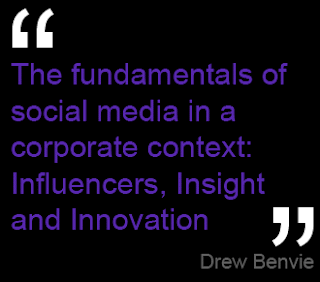
stressed the fundamentals of social media in a corporate context are Influencers, Insight and Innovation, the "three I's". Ian Burge further
explained that constant, consistent and open engagement is a vital element of a
corporate social media strategy. But how do you actually successfully practice
what you preach?
@IanBurgePR
@nickmasters
Follow us on Twitter @AbchurchComms

The Budget
is always a big date in the corporate calendar because of its impact on Tax,
and Nick Masters of PwC explained how they ran live coverage through a variety
of their digital channels in order to provide real-time commentary and opinions
about the implications. PwC made excellent use of social media to engage with its stakeholders at this
important time. Proving to be highly effective with increased media coverage,
Nick Masters even experienced a significant decrease in journalist calls as
they were offered information through online platforms.
Some
interesting legal matters were also raised, including the implementation of
social media use policies: when does an employee have a right to privacy and what
counts as communicating in a public forum? Where social media is concerned, and
with complicated privacy settings on many social sites, the lines can be very
blurry. Graham Shaw, an employment law specialist, said that in order to
minimise the risk of reputational damage and breaches of confidentiality, an
organisational social media policy needs to be established, preferably with
input from the PRs and those who will be implementing the social strategy.
The
concluding message from the board of speakers was “don’t be scared of social
media” – there is a lot of unchartered water so you won’t always know what the
outcome will be, but it will usually be good. While the panellists accepted
that some companies prefer to be private with their affairs, they maintained
that listening is an integral part of a social strategy, giving companies an
awareness of what is being said about them online. If you don’t try using
social media as part of your communications strategy, you will never experience the
potential results.
@IanBurgePR
@nickmasters
Follow us on Twitter @AbchurchComms
Friday, 6 July 2012
It’s time to turnaround: a discussion of turnaround investing
Event: Building Business in the 21st Century
Date: Wednesday 4th July
Location: K&L Gates, One New Change, City ofLondon
 Next up was Jon Moulton, Chairman and Founder of Better Capital. Jon is extremely well known in the City and
has over 30 years experience of turnarounds. Better Capital recently hit the
headlines with the acquisition of Jaeger, the high-end fashion brand and retailer. Jon certainly
didn’t mince his words about the sorts of problems they come across within
companies when assessing them. After summing up what Better Capital does Jon
discussed the cut throat nature of turnarounds, his experiences and why many companies
need to be reinvigorated. His insights into how his team goes about the process
were incredibly interesting and his notion that they look for bad management
challenged the preconception that private equity looks for strong management
teams. In turnaround situations, Jon explained, this is one of the most
straightforward things to improve and change.
Follow us on Twitter @AbchurchComms
Date: Wednesday 4th July
Location: K&L Gates, One New Change, City of
The world
of turnaround investment is not a sector for the easily offended, a sector
where a sizeable return on investment is sought above everything else. If a
change, however large or disruptive it may be, makes financial sense then it is
almost certain to happen. When International Law Firm K&L Gates LLP and Clearwater
The event
began with a presentation from Simon Peckham, CEO of Melrose plc, a listed company
that looks to acquire businesses,
improve them and realise the value created as a result. In simple terms their
investment strategy is to buy, improve and sell businesses. Simon discussed Melrose Melrose
 Next up was Jon Moulton, Chairman and Founder of Better Capital. Jon is extremely well known in the City and
has over 30 years experience of turnarounds. Better Capital recently hit the
headlines with the acquisition of Jaeger, the high-end fashion brand and retailer. Jon certainly
didn’t mince his words about the sorts of problems they come across within
companies when assessing them. After summing up what Better Capital does Jon
discussed the cut throat nature of turnarounds, his experiences and why many companies
need to be reinvigorated. His insights into how his team goes about the process
were incredibly interesting and his notion that they look for bad management
challenged the preconception that private equity looks for strong management
teams. In turnaround situations, Jon explained, this is one of the most
straightforward things to improve and change.
One of the
most interesting points that arose was the pace at which change is implemented.
If a company is taken over, the changes (management alterations, asset disposal
etc.) required to reverse the company’s fortunes are implemented immediately,
and both speakers emphasised that decisive action had to be taken within the
initial weeks. Another interesting point
was how far ahead turnaround specialists plan when looking at a prospective
purchase. When initially looking to acquire a company, Jon claimed Better
Capital would already have an idea of how or when it would look to sell the
Company.

The turnaround sector is in an interesting position at the moment. While the
economy experiences ongoing challenges, there are many companies that could be
depressed in value and therefore perfectly poised for a takeover and turnaround,
however the lack of finance available means caution is at an all time high and
any acquisition is riskier than usual. Turnarounds are a fascinating period in
the life cycle of a company and the rewards are there to be taken for those who
have the skill, capital and nerve to act quickly.
Thank you to K&L Gates for hosting a really enjoyable and thoroughly
interesting insight in to a fast-moving sector.
The turnaround investing presentations given at the event can be found
at this link: http://www.klgates.com/files/Publication/7ac6ac5c-c38c-4a5b-bd72-2ea1293dc19c/Presentation/PublicationAttachment/66b5fbfd-5ff1-48bf-bcae-2ffc4cffe6bd/FINAL%20Building%20Businesses%20slides.pdf
Oli H
Oli H
Follow us on Twitter @AbchurchComms
Wednesday, 27 June 2012
How to IPO: advice for Cleantech companies
 Event: London Stock Exchange Cleantech IPO Forum 2012
Date: Wednesday 20th June
Location: London Stock Exchange, London , UK
On this picturesque British Summer morning, the Abchurch Cleantech team made the short venture across the City to
Paternoster Square and the London Stock Exchange for the 2nd Annual Cleantech IPO Forum; a 'How to IPO' guide for cleantech companies considering floating on the Stock Exchange. Organised by Clean Energy Pipeline, we were pleased to be a sponsor alongside other IPO advisers Bird & Bird LLP, KPMG and Nomura Code Securities.
Paternoster Square and the London Stock Exchange for the 2nd Annual Cleantech IPO Forum; a 'How to IPO' guide for cleantech companies considering floating on the Stock Exchange. Organised by Clean Energy Pipeline, we were pleased to be a sponsor alongside other IPO advisers Bird & Bird LLP, KPMG and Nomura Code Securities.
After arriving at the building and navigating through the rather intimidating revolving doors, we were greeted by the alluring aroma of coffee and breakfast pastries. As the clock struck 9, a great selection of Cleantech companies were ushered through to the auditorium where the conference commenced with a welcome note from Sam Rossiter, Product Manager of Capital Markets Events at the LSE. Kicking off the presentations was Axel Kalinowski, Business Development Manager of Primary Markets at the London Stock Exchange. He gave an insightful overview of the Main Market and
 After a rejuvenating coffee and biscuit break, session two kicked off. First up was Connie Mixon from MyCelx giving a thorough case-study overview of the IPO process; from what to expect in life as a listed company on AIM. She similarly stressed the importance of your advisors, and in particular, how beneficial the Financial PR house was - comments which we greatly appreciated hearing! Bird & Bird LLP then navigated us through the legal issues of taking a company public. Matt Bonass and Vanessa Young addressed what to expect from the lawyers, the choices of market on which to launch and IPO preparation. Another Q&A session and coffee break and it was time for the final round. Gregory Hughes, director at KPMG, talked through the financial reporting pre and post-IPO. He highlighted the regulatory requirements necessary on the main market and
The concluding presentation summarised a fund manager’s view with respect to investing in cleantech. Hyewon Kong from WHEB Asset Management explored the key themes and factors driving stock selection. There was a strong focus on sustainability; capturing new investment opportunities created by long term social, demographic and environmental challenges. They are not just looking for a product and how it brings benefit to the society and environment, but companies which provide real solutions to the challenges. These cleantech companies need to illustrate how they will maintain margins in an increasingly competitive landscape and have a focused strategy in terms of growth.
 The resounding message of the conference on IPOs seemed to agree that while it is a volatile market at present and investment has seen a slight downturn as some fund managers concentrate on maintaining their current portfolio rather than investing in new companies, the cleantech theme remains a strong growth driver. In particular, investors like companies which are driven by regulation, as they may be somewhat insulated by the economic climate and public spending cuts. So, why IPO? Intial public offerings and life as a publically listed company offer enormous benefits; from increased access to capital to greater efficiency and corporate governance.
Overall, the conference was an excellent opportunity for companies to get a full grasp of how to IPO and what is involved in the IPO process, to identify the key players involved and what to expect when you decide to float on the Stock Exchange. For any ‘newbie’ into the industry, it acted as a constructive and worthwhile training morning, answering in great detail the popular "What is an IPO?" question. We heard the full IPO story directly from the industry experts and I would highly recommend attendance for future conferences. And, if your own personal development isn’t quite enough to tempt you, after the final closing remarks, you are served up with a delicious two course lunch and a chance to network and meet some of the experts.
Subscribe to:
Posts (Atom)